
For the full list of books and a deep-dive into the first book on the list, see 5 Books That Changed My Mindset – Pt.1.
The year was 2017 and I was deeply engaged in figuring out how we might extract ourselves from the deep hole of debt we were mired in. I was binging (and cringing at) The Dave Ramsey Show podcast and had doggedly made my way through The Total Money Makeover, but something wasn’t quite clicking. Then I ended up with The 4-Hour Workweek in my hands. Sadly I can’t tell you how that came about. Did I stumble across a Tim Ferriss podcast episode that led me to the book? Did I find the book on some “Top Books to Help You Get Your Act Together” list? I truly have no idea. It bugs me because today I would call myself a bonafide Tim Ferriss disciple. Everything Tim Ferriss I found myself saying “YES! PREACH!” I just relate to the directness of Optimal Efficiency Bros. What can I say.
5 BOOKS THAT CHANGED MY MINDSET – BOOK 2: THE 4-Hour Workweek.
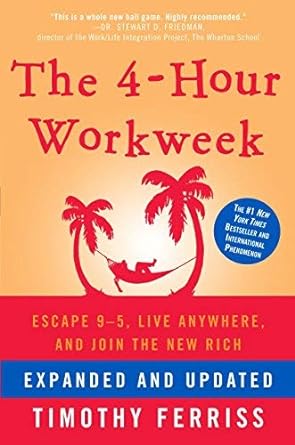
So The 4-Hour Workweek found me one way or another and it seismically shifted my mindset on just about everything I was supposed to want, according to external influences about work and life up to that point. To go ahead and use this highly over-used phrase, it resonated. This was a book about Lifestyle Design (also a highly-overused, but not inaccurately descriptive, term).
In the first six-ish years post-college, I had been grinding along without a tremendous amount of meaning behind what I was doing – I was a hard-work-hustler naturally, but didn’t have any sort of answer for where that might lead. I hated the “traditional” work concept I was being fed that equated to “work for X years and then stop working.” Yay. Not. I didn’t hate working as a general concept and simply arriving to a point someday where I wasn’t doing anything looked bleak. But I was beginning to understand that time is shockingly finite and going to an office all the time was eating up a lot of my hiking adventure hours. Why wasn’t there a better option?
The 4-Hour Workweek provided a peek behind the possibility curtain of location-independent work before remote work was really a thing. I was OBSESSED with this concept. Optimizing and automating whatever one could in order to gain back time to spend in a location I actually wanted to be? Yes please. But how to do this as a W-2 employee? Well, the key for me at the time was pursuing work or adapting work to fit my desired lifestyle, not working to achieve a desired lifestyle somewhere out in the ambiguous someday. Interestingly, I realized DH and I were already doing this without having the words to spell it out yet.
Let’s take a look a few years back…
After graduating college in 2010, I went to work for a Very Big Company. This company continues today to be one of the top ten largest private companies in the United States and one of the top 100 largest private companies in the world. Yes, Very Big indeed. I will never forget one particular moment that occurred during my first week of training. I was sitting around a conference table with my fellow trainees (I happened to be the only female in this particular group), and two executives (a male and a female) were waxing poetic about the amazing opportunities that awaited us as we scaled the corporate ladder. While I don’t remember what the male executive was saying, I remember the rest of the training group was bobbing their heads in enthusiastic agreement. The female executive seemed to notice that I was not feeling as inspired as my colleagues by what was being presented and she took the opportunity to turn attention to me directly.
In one swift and dramatic motion, she hoisted from the chair next to her and plunked with gusto atop the conference table, a giant Coach purse. She said something like, “Jennifer, with the trajectory we’re proposing for your career, you could buy one of these purses every month. You could have a closet full of these bags!”
Now, let’s ignore for a moment the very gender-specific consumerism pandering that is occurring here, as well as the fact that a (male) friend of mine who worked at Chanel at the time would have said that a Coach purse is nothing to brag about – instead, I’ll note my internal reaction: I thought, “That’s it? I’m supposed to get excited about working 50+ hours a week so eventually I can own a closet full of mid-range purses?” I was, to say the least, not inspired by this possibility.
However, I didn’t have any solid framework yet for evaluating what I really wanted out of life, so I stuck with it for a bit (and ultimately I’m glad I did – DH and I met while both working for that company). Then in 2015, after DH became a teacher, a fascinating concept arose in my mind. We could live anywhere! We could select a teaching position based on the lifestyle we wanted. At the time, this seemed like a groundbreaking concept to me. People I went to college with moved to chase salaries, they didn’t choose where they wanted to live and then select an income source that supported that instead.
Yet being presented with this opportunity suddenly made all the sense to me in the world – and at this time in my life, I wanted to live at the beach. Growing up in the mountains, the beach seemed like “The Dream” to me. So, we decided to move to the beach! I’ll also never forget the conversation I had with my current supervisor when I gave my notice. It went something like, “The beach? I mean, that’s somewhere I would like to live when I retire, but it doesn’t make sense right now.”
A whole new philosophy started for me with this decision. Whatever lifestyle you envision for future you, go get that now. Because here’s another funny thing…
What you think you want later in retirement, you might not actually want by the time you get there.
“The Dream” evolves over time. We’re allowed to change our minds. I no longer live at the beach. As it turns out, the beach is not actually all that ideal when you’ve entered a phase of your life where you want to spend all your free time hiking. Maybe I’ll want to go back later, maybe I won’t. However, I am certain that if I waited until traditional retirement age to try it out, I very well may have been disappointed.
This is as good a spot as any to pause and include a recent quote from Jack Raines, who authors the fantastic Young Money blog:
“Spending years doing something you hate to eventually make enough money to do something that you like is just procrastination disguised as ambition.”
Ok, back to The 4-Hour Workweek. This book is essentially The Bible for some and difficult to get into for others. Case in point, DH tried to read this book 3 or 4 times before he committed to push through (and has been referencing it with frequency ever since, by the way). I found The 4-Hour Workweek profoundly impactful because it dramatically shifted my mindset about work and life. At a time when I was struggling with debt and unsatisfied with conventional work advice, Ferriss’s ideas resonated deeply with my desire for a more meaningful lifestyle. It gave me a reason to carry through with our debt payoff plan using the strategies from The Total Money Makeover.
The concept of optimizing and automating work to gain more free time, especially the idea of location-independent work, hit home for me. The notion of designing my work choices to fit my desired lifestyle rather than working with the purpose of eventually attaining that lifestyle made sense. This realization led me to prioritize living the life I envisioned now, rather than waiting. DH and I continue to operate our lives through this framework, and I don’t see that ever changing.
There is so much gold in this book, even if some of the specific tactics are outdated today. Despite the title, I have never thought this book is about literally only working four hours a week or drinking margaritas on the beach day in and day out. This book is about allocating your time optimally and establishing effective systems that do not necessarily require your active presence in order to operate properly. I think about this constantly as I have continued to spend time in leadership roles. A leader that operates a company/team/etc. in a manner that the system will fail if he/she is unavailable has not done an effective job. An organization that runs smoothly while that leader steps away for a month-long trip abroad with family, well, that leader has created a truly effective system.
How much better could we all be at our professional and personal lives if we disconnected quantity of hours from the actual thing that needs to happen?
Doing less does not equal being lazy. In fact, busyness often is equivocal to laziness. Both are just perpetual activity left unexamined.
–That might be a version of a quote, the source of which I’m forgetting. Bet you I heard it on the Tim Ferriss Show.
 the Piper Paradigm.
Leave a comment