
I get asked regularly for specific recommendations – What’s the best travel rewards credit card? What worksheets do you use for end-of-year planning? What podcasts do you recommend? etc. I have also posed these and many other questions over the last several years to other people. So in addition to sharing rambling thoughts, I plan to share specific tools, maybe a few products, actionable items, and more.
Let’s start with books. It is a true marvel of civilization that we have access to the deep and extensive knowledge of an incredible number of experts on a plethora of topics for the sum of a few dollars (or free, if you utilize your local library). I am convinced that the absolute best ROI out there from a tangible product comes from books.
DH and I talk about nearly every purchase before we make it (not because we necessarily need to at this point, but because it’s become part of our process) – but books are always a YES. Personally, I read everything. There is no category of book that I am uninterested in. I maintain a To Be Read (TBR) pile of about 50 books, and have a list of another 400 or so I would like to acquire at some point. I read roughly 50 books a year, and like to have a fiction and non-fiction going at the same time. I’m just letting you know I’ve done my homework before making these recommendations.
It’s worth noting that I read all five of the books I want to share with you since 2017 – the year we first began to aggressively pay down debt. It is absolutely fascinating how one decision to improve your life compounds – it’s virtually impossible to choose to better yourself in one area and not subsequently improve other areas. Go ahead and give it a try!
I am listing these in the order I read them, noting the year in which I read them, and I will be including my thoughts on during what stage in your journey I would recommend them. Plain and simple – If you have never thought about Financial Independence before today, read The Total Money Makeover, then Rich Dad, Poor Dad, then read Die With Zero after you have taken action from the first two books. The 4-Hour Workweek and Outlive can fit in whenever you feel you are leaning towards a mindset of thinking and acting differently than the majority of the humans you know.
The Five Book List:
- The Total Money Makeover – Read in 2017.
- The 4-Hour Workweek – Read in 2017.
- Rich Dad, Poor Dad – Read in 2022.
- Die With Zero – Read in 2022.
- Outlive – Read in 2023.
Ok, time for a deep-dive.
5 Books That Changed My Mindset – Book 1: The Total Money Makeover.
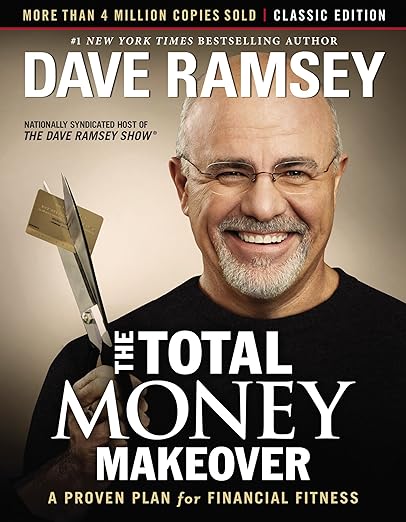
The Total Money Makeover – This book is for: Anyone who’s intentionality with money goes about as far as “I work, I get paid, I try to not spend more than I get paid.” If you have debt and think either 1) “I can make the monthly payment so the debt I have is fine” or 2) “I have a hard time making my monthly payments and wish things were different but I don’t know where to start” – read this.
I only read this book because I got deep into listening to the Dave Ramsey Podcast first. This book (in my opinion) is a perfect example of everything that makes financial books so generally unapproachable (and flat out uninteresting) to young(ish) individuals like myself. Look at the cover of this book… Why would I ever want to pick up this book? Do you also think this is the most boring-looking book of all time? I’m not sure I can even tell you that this is, in fact, an interesting book. That might be a bit disingenuous. I know, I know… I’m not doing a great job convincing you to read this book. But some things just work, and this is one of them. How about this – this book is described as, “…the simplest, most straightforward game plan for completely changing your finances.” Simple and straightforward when it comes to finances? SOLD. The big, huge value I found in this book (and the Dave Ramsey podcast) is I began to understand just how much control I truly DO have over my financial well-being. I may even go as far to say it was shocking to DH and I, and those around us, to see just how much control we were able to exert over our future in two short years because we began rigorously following “The Steps.” Dave Ramsey’s process is focused around seven baby steps. And guess what?
I only care about the first three steps.
Only three steps to be on my way to financial freedom?! Why isn’t EVERYONE buying this book?? There must be a catch…
Sure, ok. The catch is it’s simple, not easy.
And maybe all seven steps are best for you, that’s for you to decide. Just for fun, I’ll give them all to you here with my thoughts on each:
The Seven Baby Steps:
Step 1: Save $1,000 for your starter emergency fund. – YES. Do this now. Do this yesterday. No emergency fund is a dangerous place to be my friend. Maybe even do this before you buy any more books (yup, I said it). In today’s world, I might make this higher. What amount would help you sleep at night? If you have had an unexpected emergency cost in the past, that might make a good benchmark for this number. Don’t make it too big (after all, we’re just starting here), but make it a true starter emergency fund. Start squirreling away those dollars and cents in a good ‘ol savings account until you hit this number. Then leave it alone. Pretend it doesn’t exist. How does one find money for this emergency fund? This is one of the magical discoveries you will make when you learn to create a monthly budget! Perhaps I’ll refer to “the budget” as sub-Step 1.
Step 2: Pay off all debt (except mortgage debt) using the debt snowball. – YES. This was a pivotal activity for DH and I. Really it was THE pivotal activity for us. If you have a partner, I personally believe this is the best thing you can do for your marriage. It teaches you to work (very) hard together towards a common goal as a team. A marriage is literally a business partnership (so romantic, I know) whether you want to acknowledge that or not. Business partnerships can be powerful, but they can also be disastrous if the partners are unable to drive the business forward in the same direction together. With a partner or not, this step is the most difficult. But once you get that first win, OH MAN, you will be unstoppable. You will have tangible proof of the power you have. And no one can take the knowledge of that power away from you. Again, the “debt snowball” is simple, not easy. List all your debts smallest to largest, attack the smallest one first, paying only the minimum on the others. Roll whatever you were able to manage as a monthly payment (minimum plus extra) on the smallest debt in to attacking the next one, and repeat.
Step 3: Save 3–6 months of expenses in a fully funded emergency fund. – YES. But first… take a quick moment to celebrate that you just paid off all that debt. That is A Big Deal. Ok, my high-level thoughts on an emergency fund – I like a 6 month fully funded lifestyle emergency fund. Why? Simply because I sleep very well with that. Our emergency fund would allow us both to not earn any income for 6 months and we would we be able to maintain our current lifestyle during that period. We could both earn zero income for a year and cover all basic necessary expenses (housing, transportation, groceries, medical, etc). For some, this is too conservative. But that’s the thing – YOU get to decide what this looks like. Curious how to figure out how to determine this amount? You learned how to budget meticulously in the first two steps so you have all the datapoints you need! MAGIC!
Like I said, I only really care about those first 3 steps. Brief thoughts on the rest:
Step 4: Invest 15% of your household income in retirement. -Yes, invest. But this percentage should depend on what your goals are. We plan to be Financially Independent earlier than traditional retirement age, therefore this percentage is much higher for us.
Step 5: Save for your children’s college fund. -We don’t have kids. So there’s that.
Step 6: Pay off your home early. -I look at mortgage debt as a completely separate tool in the financial tool kit (more on that in Rich Dad, Poor Dad). My thoughts on this step/philosophy are a post for another day.
Step 7: Build wealth and give. -Sure. But this is a HUGE playing field and looks vastly different from person to person. Much more is required in this arena than what you’ll get from this book.
And there you go, the first of five books that changed my mindset. After reading The Total Money Makeover, I realized that, despite the many aspects of life beyond my control, I have the power to shape my own financial future.
Have you read The Total Money Makeover? I’d love to know what you think!

 the Piper Paradigm.
Leave a reply to 5 Books That Changed My Mindset – Pt. 2. – the Piper Paradigm. Cancel reply